
PULA ARENA HISTORY – ORIGIN & HISTORICAL EVENTS
Pula Arena: Ancient Roman amphitheater by the sea
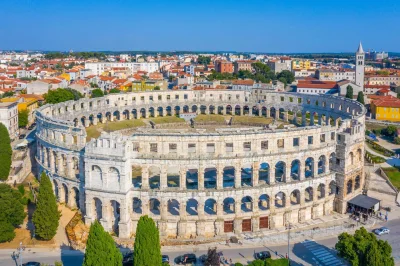
Located in Croatia, Pula Arena is one of the best-preserved Roman amphitheaters in the world. It once hosted gladiator fights and public events. The arena could hold around 23,000 spectators. Today, it stands as a symbol of Roman architecture and Croatian heritage. When visiting Pula Arena, travelers can explore its historic arches and imagine ancient spectacles as they walk through the same corridors where gladiators once stood. Pula Arena is also a popular site for concerts and festivals, blending history with modern culture.

Construction of Pula Arena
The Pula Arena was built during the reign of Emperor Vespasian (69–79 AD). The arena was part of Rome’s growth in Dalmatia, including the Istria region. Made from local limestone, the amphitheater has an elliptical shape. It measures 132 meters long and 105 meters wide. The façade stands about 32 meters tall and has three floors. The top floor had arches that once held an awning to shade the crowd.

Timeless structure built to last
The amphitheatre in Pula is one of the rare ancient arenas in the world that remains fully intact on all sides and ranks as the sixth largest globally. A common question about this structure is how it has survived for thousands of years with so little damage. One key reason lies in the choice of building materials. The Pula amphitheatre was primarily built using limestone. These materials were sourced locally and reflect typical Roman construction methods designed to strengthen and preserve their buildings. The arena’s arches are a defining feature, expertly engineered to bear the heavy loads from above, a technique widely used in Roman amphitheatres.
Underground area
The hypogeum beneath the arena consisted of a network of tunnels and rooms. These areas were used to store cages for wild animals and to house gladiators before their appearances in the arena. Today, the underground chambers house a permanent exhibition titled “Viticulture and Olive Oil Production in Istria During the Roman Period”. This exhibition features reconstructed Roman tools, olive mills, wine presses, and amphorae used for storing and transporting olive oil and wine. It provides visitors with insight into the agricultural practices of ancient Istria.

The Legend of the Divic-Building
There is a legend that long ago in Istria, there were fairies who worked at night. They danced in meadows and forests and sometimes showed themselves to people, but never harmed anyone. According to legend, these fairies could bring happiness and were great builders. It is said that the fairies built the Pula Arena. They carried stones all night and arranged them in a circle to build their city called Divic-city (the old Slavic word “diva” means miracle). But since they were creatures of the night, they could only work until the rooster crowed. When the rooster sang, they had to stop working and run away before people saw them.
Because of this, Divic-city was never finished, and that is why the Arena has no roof today. All over Istria, large stones remain where the fairies dropped them after the rooster’s call stopped their work. This story likely started because people were amazed by the Arena and saw it as a miracle.

The Arena in Roman Times
In ancient times, Pula Arena hosted gladiator fights, animal hunts, and public shows. These events entertained crowds and showed Roman power and culture. People from all walks of life gathered here to watch the action. Most gladiators were former slaves or criminals, but some were free citizens who volunteered for a chance at eternal glory. It is believed that women sometimes took part in the games!

The fate of the Arena in the Middle Ages
After the fall of the Western Roman Empire, the arena was mostly used for grazing animals that fed the local people. Occasionally, fairs were held there. In the 14th century, Pula’s economy and population declined, and the arena became less important. Malaria hindered the city’s growth, so little new construction took place. This lack of development helped preserve the arena’s outer walls, which still stand today. Its arches and windows showcase the arena’s former beauty and strength.

Surviving through the years
In about 1260, the Patriarch of Aquileia fined people who took stones from the amphitheater. Later, in 1458, the city council of Pula made a law to stop people from using or selling parts of the arena’s stone. Much of the stone had already been used to build palaces and squares during Venetian rule.
Despite these efforts, over the following centuries, many stones from the amphitheater continued to be removed and repurposed. By the 19th century, around 1840, people grew concerned that the Pula Amphitheater might disappear completely. Iron bars that helped strengthen the outer walls were removed, and large blocks from the seating area were taken as building materials. Because of this, the arena had effectively become a quarry for valuable stone.

Story about the world’s biggest tie
In the 17th century, Croats wore distinctive bandanas around their necks as part of their traditional uniforms. It was customary for women to give these bandanas to their loved ones before they went off to war, symbolizing loyalty and faithfulness. Over time, the necktie evolved into a symbol of elegance and style across Europe.
On October 18, 2003, the Pula Arena became the site for the world’s largest tie. Named “Kravata oko Arene”, the tie measured 808 meters in length and 25 meters in width, constructed from 9,015 square meters of red fabric. Nearly one hundred children helped stretch the enormous tie along the Pula waterfront.
Pula Arena today
Today, the Pula Arena is a popular tourist attraction and a lively venue for events. One of its most famous gatherings is the Pula Film Festival, which started in 1954 as the Festival of Yugoslav Film. After a pause in 1991, it returned in 1992 as the Croatian Film Awards Festival, more commonly known as the Pula Film Festival.
In addition to film, the arena has hosted live music performances by famous artists like Luciano Pavarotti, Jose Carreras, Sting and Dua Lipa. Although these concerts differ greatly from the gladiator battles of ancient Rome, they share the same goal: to entertain the crowds. In this way, the Pula Arena still serves the purpose it was originally built for by the Romans. However, if you prefer to experience the amphitheater’s grand architecture away from the noise of the crowds, you can book Pula Arena tickets and tours to find a moment of peace and quiet among the ancient stones before the evening’s festivities begin.
Learn more about Pula Arena and its history!

Live Tour Guide
Arena Pula Guided Tour
Join a Pula Arena tour and step inside a 2,000-year-old ancient amphitheater. See where 20,000 people once watched gladiatorial battles. Walk through all four original towers, and explore underground tunnels with Roman artifacts. Hear real stories about its past and transformation into a cultural center from a live guide. Reserve your spot on the tour and explore Pula’s most iconic landmark up close!

skip the line ticket
Arena Pula Skip-the-Line Tickets
Discover the ancient Roman amphitheatre with Pula Arena priority entry tickets. Get access to the amphitheatre and the underground gladiator area. See real Roman-era artifacts and explore 2,000 years of history at the permanent exhibition. With Pula Amphitheatre tickets, you’ll get a complete and easy visit to this iconic landmark. Secure your entry tickets today and step into history!